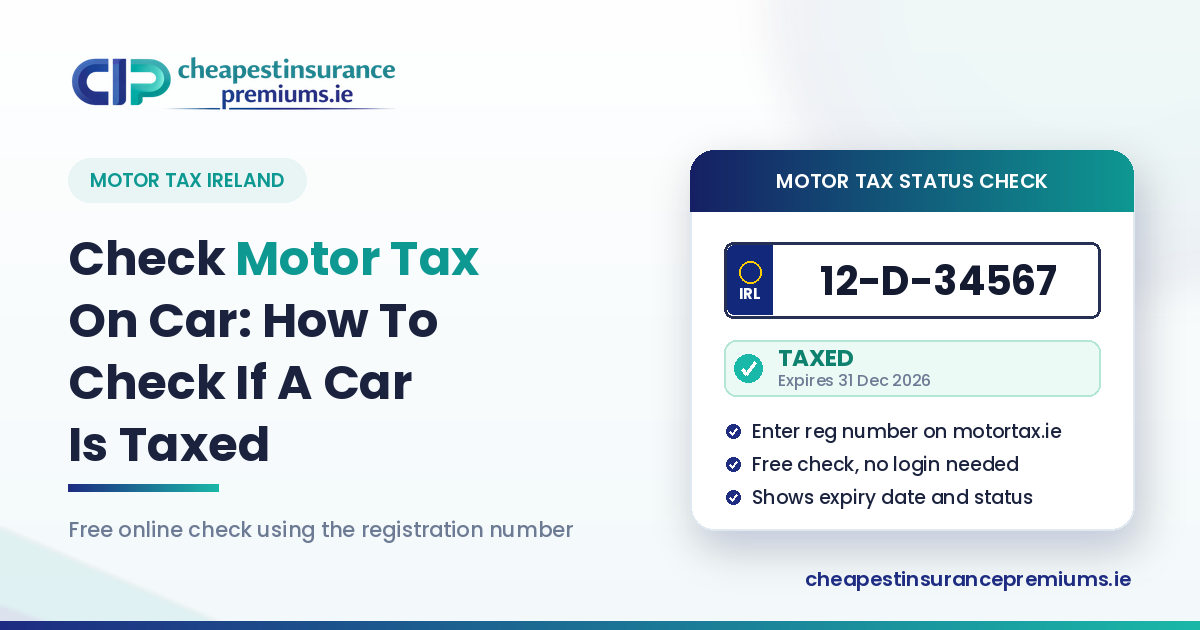
Quick Answer: To check motor tax on car records in Ireland, go to the Government’s free Check My Vehicle service at vehicleservices, enter the Irish registration number, and the tool returns the vehicle’s motor tax status, expiry date, tax class and NCT or CVRT status. It is free, instant, and you do not need to own the vehicle or create an account.
Why You Might Need to Check Motor Tax on a Car
Most people search for how to check motor tax on car details for one of two reasons: they are about to buy a second-hand car and want to verify what they are actually paying for, or their own renewal date has slipped their mind and the reminder never arrived in the post.
Either way, the check takes under a minute and costs nothing. What matters more is knowing how to read the result, because “expired” in Ireland is a far more expensive situation than most drivers realise, and the fix is not as simple as logging into motortax.ie and paying.
This guide covers the free check, what each status means, what happens when tax lapses, and how motor tax, NCT and motor insurance all interlock, because you cannot legally tax a car in Ireland without valid insurance in place.
How to Check Motor Tax on Car Records: Step by Step
The Department of Transport runs a free public lookup called Check My Vehicle, which draws directly from the National Vehicle and Driver File (NVDF), the same database that underpins ownership transfers and tax renewals.
Step 1. Go to the official tool.
Visit vehicleservices. Bookmark it. There are dozens of lookalike sites that charge for the same public data.
Step 2. Enter the registration number.
Type the Irish reg exactly as it appears on the plate (for example, 191-D-12345). No spaces, dashes or formatting required, the system is forgiving.
Step 3. Read the result.
You will see the tax status, expiry date, tax class, basis of assessment, and the NCT or CVRT expiry.
Step 4. Cross-check the date.
Motor tax in Ireland always expires on the last day of a calendar month. If the tool shows “31 August 2026”, you have until midnight on that date, not a day beyond.
Step 5. Allow for a data lag.
If you have just paid or just passed an NCT, the public record can take up to 24 hours to update. Check again the next day before assuming something is wrong.
Quick comparison:
| Check My Vehicle | Motor Tax Online | |
| Cost | Free | Free to check |
| What you need | Reg number only | Reg number (PIN to pay) |
| Shows tax status | Yes | Yes |
| Shows NCT / CVRT | Yes | No |
| Lets you pay | No | Yes |
| Works for any vehicle | Yes | Yes, to check |
What Does Check My Vehicle Actually Show You?
Once you enter a registration number, the service displays:
- Whether motor tax is currently valid
- The expiry date of the current tax disc
- The tax class (private, goods, etc.) and basis of assessment (CO2 emissions or engine size)
- NCT status and expiry for private cars
- CVRT status for commercial vehicles and vans
That last point matters if you’re buying a van or a light commercial. Commercial vehicles sit under the CVRT regime rather than the NCT, and they’re also taxed differently, which affects both your running costs and how you’ll need to arrange cover. If you’re buying commercially, it’s worth reading up on van insurance and commercial insurance before you commit, because the premium can differ sharply from a private car equivalent.
| Field | What it tells you | Why it matters |
| Motor tax status | Whether tax is currently in date | The headline yes/no answer |
| Tax expiry date | Last day of the paid-up period | Sets your renewal deadline |
| Tax class | Private, goods, vintage, etc. | Goods/commercial classes have different rules |
| Basis of assessment | CO2 emissions or engine size (cc) | Tells you how the annual rate is calculated |
| NCT / CVRT expiry | Roadworthiness test status | You cannot renew tax online with an expired test |
What it does not show: the tool gives you a snapshot, not a history. It will not reveal how long a car has been untaxed, whether there are gaps in its tax history, or how much is owed in arrears. For a used-car purchase where the history matters, a paid vehicle history report (Cartell, MotorCheck) fills that gap.
What Each Motor Tax Status Means
A few statuses cause confusion. Here’s what they actually mean.
“Taxed” with a future expiry date
Straightforward, the vehicle is legal to use on public roads until that date. Note that motor tax discs always run to the last day of a calendar month, so a disc showing 31 October expires at midnight on the 31st, not on the anniversary of when you paid.
“Expired”
The tax has lapsed. Driving the vehicle on a public road is now an offence, and arrears begin accruing immediately (more on that below).
“Declared off the road”
The registered owner has filed a Statutory Off-Road Declaration, commonly called a SORD, submitted on Form RF150. This is Ireland’s equivalent of the UK’s SORN. It means the owner has formally told the Motor Tax Office the vehicle won’t be used or parked in a public place for a stated period, and no motor tax is due for those months.
Important: a vehicle under an off-road declaration cannot legally be driven on a public road during that period, not even to the garage. If you’re buying a car with this status, the seller will need to re-tax it before you can drive it away, or you’ll need to trailer it.
Checking Motor Tax Before You Buy a Used Car
Running a reg check is the cheapest piece of due diligence available to a private buyer. Before you hand over any money:
- Check motor tax and NCT status on Check My Vehicle, an expired NCT is a bargaining point and a cost you will inherit.
- Note the tax class. A van or jeep taxed commercially will be re-assessed at the (much higher) private rate if you use it privately. This catches people out constantly.
- Note the basis of assessment. A pre-July 2008 car is taxed on engine size; from July 2008 to December 2020 it is CO2 (NEDC); from January 2021 it is CO2 (WLTP). The same model can carry wildly different annual costs depending on its first registration date.
- Confirm the seller is the registered owner and that the Vehicle Registration Certificate (VRC) is present, you will need the last six digits as your PIN to tax it online.
- Arrange insurance before you drive it away. Tax and NCT mean nothing without cover, and you cannot complete the tax transaction without insurance details.
Buying this week? Compare cover from Ireland’s leading insurers before you collect the car get a motor insurance quote here.
You Cannot Tax a Car Without Insurance
This is the part most guides skip. Motor tax, NCT and insurance are three separate legal requirements, but they are procedurally linked:
- Insurance is required to tax. The motor tax application requires you to declare your insurer and policy details. No active policy, no tax.
- A valid NCT/CVRT is required to tax online. motortax.ie will refuse the transaction if the test certificate has expired, check the NCT date first to avoid a failed payment.
- Tax does not make you legal on its own. A taxed, NCT’d car driven without insurance is still an uninsured vehicle, with far heavier penalties than an untaxed one.
If your policy is coming up for renewal at the same time as your tax, it is worth comparing the market rather than auto-renewing. You can compare motor insurance quotes in a few minutes, and if you run a van for work, our van insurance options cover both private and commercial use.
Why the Status Might Look Wrong
Two things trip people up when they check motor tax on a car:
The data isn’t live. If you’ve just taxed the vehicle or passed an NCT, it can take up to 24 hours for the record to update. If you check straight after paying and it still shows as expired, wait a day and check again before panicking.
It’s Irish-registered vehicles only. Check My Vehicle won’t return anything for a UK, Northern Irish or other foreign registration. For a UK plate you’d need the DVLA’s own vehicle enquiry service. And if you’re buying a UK import that’s been re-registered here, the Irish record starts from the date of registration in Ireland, the vehicle’s earlier history won’t show up, which is one of the reasons a paid history report from a commercial provider is worth the money on an import.
What If the Motor Tax Has Expired?
This is where it gets expensive, and where most guides stop short.
Arrears build up automatically
Once a disc expires, arrears accrue at one-tenth of the annual rate for every month, or part of a month, that the vehicle stays untaxed. A part-month counts as a full month. On a car taxed at 270 euro a year, that’s roughly 27 euro for every month you’re late, and there’s no grace period.
You’ll be locked out of online renewal
Once there’s any gap between your last disc (or off-road declaration) and today, motortax.ie will typically refuse the transaction. Clearing arrears generally means attending your local Motor Taxation Office in person with your VRC, insurance details, a valid NCT and payment covering both the arrears and the new tax period.
You can’t backdate an off-road declaration
Since the Non-Use of Motor Vehicles Act 2013, a Form RF150 must be filed in advance, during the month your current tax expires, or within 21 days of buying or importing the vehicle. You can’t file it retrospectively to wipe out months you’ve already missed. Off-road declarations also run for a minimum of 3 months and a maximum of 12, and you won’t be permitted to file one at all if arrears are outstanding on the vehicle.
Rules and figures change. Confirm current amounts with your local Motor Taxation Office or motortax.ie before making a payment.
Checking Motor Tax on Vans, Jeeps and Commercial Vehicles
The Check My Vehicle tool works the same way for commercial vehicles, but it shows CVRT (Commercial Vehicle Roadworthiness Test) status rather than NCT, and the tax class will read as goods or commercial.
Two things to be aware of:
- Commercial rates come with conditions. Goods-rate motor tax generally requires the vehicle to be used solely for business purposes, and a Goods Declaration (Form RF111A) is typically needed. Using a commercially taxed vehicle for the school run can put you outside the terms of that rate.
- First-time commercial taxing usually means an office visit. Transferring a commercial vehicle into a new owner’s name is generally not completed online.
If you are taxing a van commercially, your insurance needs to match the declared use. Compare cover for vans, broader commercial and business risks, or sole trader business insurance if you are self-employed.
Checking Motor Tax on an Imported Vehicle in Ireland
Check My Vehicle only holds records for vehicles on the Irish National Vehicle and Driver File. An imported car will return nothing until it has been through Irish registration, so if you are buying an import, the sequence matters.
The order things have to happen in
- Book an NCTS appointment within 7 days of the vehicle arriving in the State.
- Complete registration and pay VRT within 30 days of arrival. Miss this and you face penalties, and Revenue can seize the vehicle.
- Receive the Irish registration number, fit Irish plates, and wait for the Vehicle Registration Certificate to issue.
- Tax the vehicle. Only at this point does it appear on the NVDF and become searchable on Check My Vehicle.
Practical implication: if a seller is offering a “freshly imported” car and the reg check returns nothing, that is not necessarily a red flag, but it does mean you are relying entirely on paperwork rather than a State record. Ask to see the VRC before money changes hands.
What determines the motor tax rate on an import
The basis of assessment is set by when and how the vehicle was originally type-approved and first registered, not by the date it was registered in Ireland:
| Original first registration | Motor tax basis |
| Before 1 July 2008 | Engine size (cc) |
| 1 July 2008 – 31 December 2020, NEDC-tested | NEDC CO2 table, even if registered in Ireland after 2021 |
| WLTP-tested vehicles | WLTP CO2 table |
| Battery electric | Flat lowest rate regardless of registration date |
A common misconception is that any car registered in Ireland from 2021 automatically falls onto the WLTP table. It does not. A 2018 UK diesel imported and registered here in 2026 is taxed on its NEDC figure.
Where imports do get caught out is VRT. Since 2021, Revenue applies an uplift formula to NEDC CO2 figures on imported vehicles to bring them into line with WLTP for VRT purposes. That uplift can push the CO2 figure recorded on the Irish VRC above the original figure on the UK V5C, and it is the figure on the VRC that governs everything afterwards.
The rule of thumb: never budget your annual motor tax from a foreign spec sheet or the original logbook. Wait for the VRC, read the basis of assessment and CO2 figure printed on it, and check that against the rates on motortax.ie.
One more thing importers forget
Your insurance needs to be in place before the vehicle is driven on Irish roads, and some insurers treat imports, particularly Japanese and grey imports, differently at quotation stage. It is worth checking that cover is available and affordable before you commit to the purchase, not after the car is sitting in your driveway. Compare motor insurance quotes here, or talk to our team if the vehicle is unusual.
You Need Insurance Before You Can Tax the Car
Here’s the step people miss when they discover their tax has run out: valid motor insurance is required to tax a vehicle in Ireland. The system checks it. So if the car has been sitting idle and both the tax and the policy have lapsed, the order of operations is insurance first, tax second, not the other way around.
Two other pre-conditions apply:
- A valid NCT is needed for cars of testable age. The online system verifies this automatically during renewal, so an out-of-date NCT will stop the transaction.
- The ownership record on the National Vehicle and Driver File must match what you’re declaring. If you’ve just bought the car and the change of ownership hasn’t gone through, taxing it will fail.
If you’re arranging cover before taxing a newly bought car, comparing across the market rather than auto-renewing is usually where the savings are. You can compare motor insurance quotes or go straight to a motor insurance quote and have the policy in place before you head to the Motor Tax Office. For a van or light commercial, start with a van insurance quote instead.
Is Motor Tax a Legal Requirement in Ireland?
Yes. Motor tax is payable on any vehicle used or parked in a public place in the Republic of Ireland, private cars, motorcycles, vans, agricultural tractors and most commercial vehicles included. The only way to avoid it legally is a valid off-road declaration.
Driving without valid motor tax carries a Fixed Charge Notice, which increases if it goes unpaid and can escalate to a court summons with a substantially higher maximum fine. There are no penalty points attached, but the vehicle can also be clamped or towed. Enforcement is largely automated: Garda ANPR-equipped patrol vehicles flag untaxed registrations as they pass, so the odds of quietly getting away with a lapsed disc are lower than they used to be.
Certain exemptions exist, for example, vehicles used by drivers or passengers with disabilities may qualify for relief under specific schemes.
Checking Motor Tax Before You Buy a Used Car
If you’re checking a car you don’t own yet, the tax status is one line on a much longer checklist. Run through these before you hand over a deposit:
- Motor tax status and expiry — via Check My Vehicle
- NCT or CVRT status — same lookup; a car sold “NCT’d” should show it
- Annual tax cost — enter the reg on motortax.ie to see the real yearly figure. A pre-2008 2.0-litre petrol can cost several times what a low-emissions 2021 car costs to tax
- Any off-road periods — long gaps can indicate the car sat unused, which brings its own mechanical issues
- Outstanding finance and write-off history — this needs a paid commercial history report; the free government tool won’t show it
- Insurance cost — get a quote before you buy, not after. Premiums vary enormously by engine size, model and driver profile, and it’s an unpleasant surprise to discover the cover costs more than you budgeted
Point 6 is the one that catches out first-time buyers most often. Running a quick insurance quote on the exact reg you’re considering takes a couple of minutes and tells you what the car will really cost to run.
Frequently Asked Questions
How do I check motor tax on a car with just the reg?
Go to vehicleservices.ie, enter the Irish registration number, and the tool returns the vehicle’s motor tax status and NCT or CVRT position. No login or payment is required.
Is it free to check motor tax on a car in Ireland?
Yes. The Government’s Check My Vehicle service at vehicleservices.gov.ie/cmv is completely free and requires no account. Any site charging for a basic tax status check is reselling public data.
Can I check if someone else’s car is taxed?
Yes. The tool is a public lookup and works with the registration number alone. You do not need to be the registered owner, which is what makes it useful when viewing a car for sale.
How long does it take for the tool to update after I pay?
Typically within 24 hours. If the status still shows as expired after a full working day, contact your local Motor Tax Office.
Do I still need to display a tax disc in Ireland?
Yes. Unlike the UK, Ireland has retained the paper disc, and it must be displayed on the windscreen. That said, enforcement increasingly relies on ANPR reading the plate against the NVDF, so a displayed disc will not help if the record says otherwise.
Is there a grace period after motor tax expires?
No. There is no official grace period. Arrears begin accruing from the first day of the following month, charged at approximately one-tenth of the annual rate per month or part-month.
Can I tax my car without an NCT?
Not online. motortax.ie will block the transaction if the NCT or CVRT has expired. Book and pass the test first.
Can I tax my car without insurance?
No. Valid insurance is required to complete a motor tax application in Ireland. If your cover has lapsed, sort the insurance first, you can get a quote here.
What is my motor tax PIN?
For a used vehicle, it is the last six digits of your Vehicle Registration Certificate (VRC). For a brand-new vehicle being taxed for the first time, it is the last six characters of the chassis (VIN) number. A PIN retrieval service is available on motortax.ie if you have lost it.
Why does my imported car return no result on Check My Vehicle?
Because it is not yet on the Irish National Vehicle and Driver File. An imported vehicle only becomes searchable once it has been registered with Revenue, issued an Irish registration number and taxed. Until then, the paperwork is your only record.
Does driving without motor tax carry penalty points?
The initial fixed charge notice for no motor tax does not carry penalty points, but it is still a fine, and continued non-payment escalates to a court summons.
The Short Version
To check motor tax on a car in Ireland, enter the registration number at Check My Vehicle, it’s free, takes seconds, and shows both tax and NCT status. If the tax has lapsed, sort your insurance and NCT first, then clear any arrears at your local Motor Taxation Office.
And if you’re arranging cover either way, it costs nothing to see what else is available. Compare motor insurance, van insurance, home insurance and travel insurance at Cheapest Insurance Premiums, or get in touch if you’d rather talk it through. More guides like this one are on our blog.
This article is for general information only and does not constitute financial or legal advice. Motor tax rates, penalties and procedures are set by the Department of Transport and can change, always confirm current details at motortax.ie or with your local Motor Taxation Office.