How to decide between a new or used car in Ireland, and what each choice really costs to run and insure.
Changing your car is one of the bigger purchases most people make, and the new or used car question rarely has an obvious answer in Ireland. A new car brings the latest safety kit and a warranty. A used one skips the steepest drop in value.
Here is how the two compare on the things that actually cost you money.
Start With Three Questions
What is the budget, really?
Not just the sticker price. The monthly repayment if you are financing, the deposit, and what your current car is worth as a trade-in. Plenty of buyers set a budget for the car and then find tax, insurance and servicing push the real cost well past it.
What do you actually need?
Seats, boot space, towing, a car that fits your driveway. Be honest about the difference between needs and wants. If you need something specific, such as a seven-seater, a particular engine or a certain spec, the used market may have fewer options and you might pay a premium to get it new. If you are flexible, used opens up a lot more choice for the same money.
How long will you keep it?
This is the question people skip, and it changes the answer more than anything else. If you keep cars for eight or ten years, buying new and running it into the ground spreads the depreciation thin. If you change every three years, you are absorbing the worst of the depreciation each time.
Depreciation: The Cost That Is Not on the Invoice
Depreciation is usually the single biggest cost of owning a new car, and it never appears on a bill.
A new car loses a significant chunk of its value in the first year and continues falling steeply for the first three. After that the curve flattens. That is the whole financial argument for buying used: you let someone else take the steepest part of the drop.
It cuts both ways though. A three-year-old car is out of warranty sooner, closer to bigger service items, and closer to the age where repairs start arriving.
New Cars: Pros and Cons
Pros
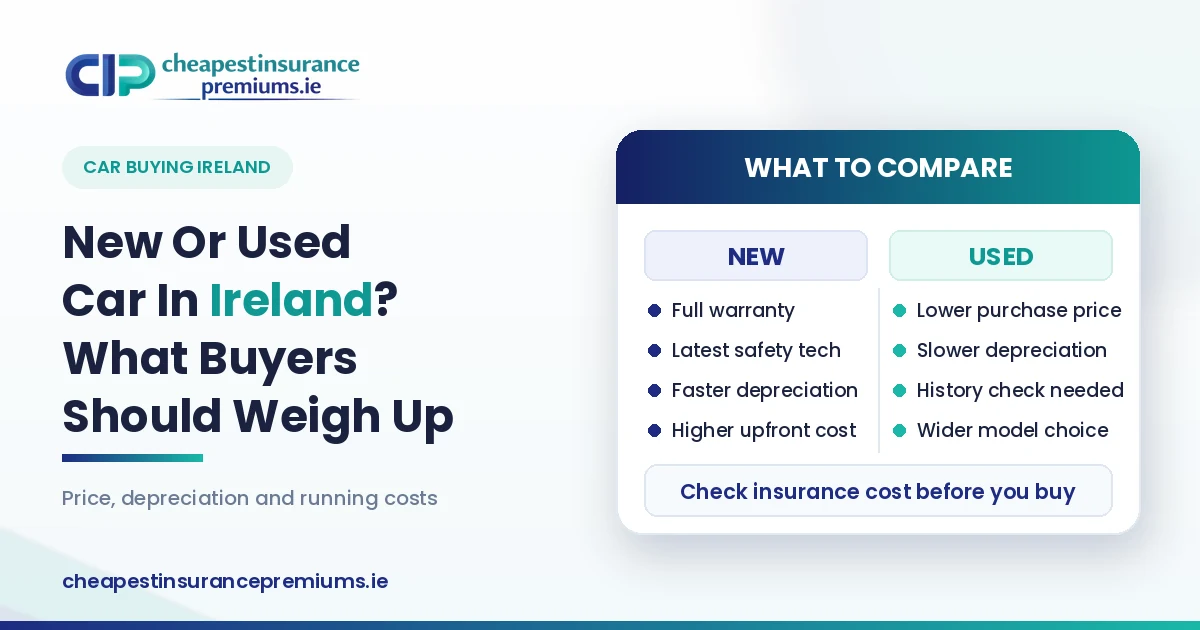
- Latest safety systems and driver aids
- Full manufacturer warranty, often with a service plan and roadside assistance
- Lower chance of an unexpected repair bill
- Better efficiency, and lower motor tax on newer, cleaner engines
- You choose the spec
- Manufacturer finance deals are often sharper than used-car rates, including 0% offers on selected models
Cons
- Highest purchase price
- Heaviest depreciation, concentrated in the first three years
- Usually more expensive to insure
- Long waits on some models
Used Cars: Pros and Cons
Pros
- Much lower purchase price
- Slower depreciation, because the worst of it has already happened
- Usually cheaper to insure
- The same budget buys a higher spec or a bigger car
Cons
- Older safety technology
- Warranty may be short or gone entirely
- Higher chance of repairs and bigger service items
- Unknown history unless you check it properly
- Finance rates on used cars are typically higher than manufacturer new-car offers
Nearly New: The Middle Ground
“Nearly new” usually means a car two to three years old, often a dealer demonstrator, an ex-lease car or a fleet return. Many are sold through main dealers with low mileage and some warranty left.
For a lot of buyers this is the sweet spot: modern safety equipment and a current-ish plate, without the first-owner depreciation hit. It is worth asking a dealer what demonstrators they have coming off the fleet, because those cars are usually well specced and well minded.
New or Used Car: The Running Costs Compared
The purchase price is the start of it. Over three or four years, these add up:
- Motor tax, based on CO₂ emissions for cars registered from 2008, so newer and cleaner generally means cheaper. Electric cars sit at the lowest rate.
- NCT, with the first test at four years, then every two years, and annually once the car passes ten. An older car means more tests and more chance of failing one.
- Servicing and repairs, because a used car is closer to timing belts, clutches, tyres and battery replacements.
- Fuel or charging, where a newer engine is usually more efficient, and home charging an EV is far cheaper per kilometre than filling a tank.
- Insurance, covered below.
A cheaper used car with higher running costs can still work out better overall. But do the sum rather than assuming.
Insurance: What Changes Between a New and Used Car
New cars generally cost more to insure. They are worth more to replace, and modern driver-assist systems mean even a light knock can involve replacing sensors, cameras and radar units behind the bumper or windscreen. Those repairs are expensive, and premiums reflect it.
Used cars are usually cheaper to insure because the replacement value is lower, but age is not the only factor. Security, safety rating, engine size, repair costs and how easy parts are to source all feed in. An older performance model can cost more to insure than a newer family hatchback.
Two things worth doing before you commit:
- Get an insurance quote on the exact model before you buy. It takes minutes and occasionally changes the decision entirely, particularly for younger drivers, where the gap between two similar cars can run into hundreds. You can compare a motor quote on each shortlisted model before you put down a deposit.
- Think about the finance shortfall on a new car. If it is written off in year one, a standard policy pays market value, which can be well below the balance on your loan. GAP cover exists for exactly that gap.
Our guide to motor insurance goes through the rest of the factors that move your premium.
If You Are Buying a Van or a Work Vehicle
The same new-or-used logic applies to commercial vehicles, but two things shift.
Vans depreciate differently to cars, and a well-maintained used van with a full service history often holds value better than the equivalent car. Against that, a van earning its keep does far higher mileage, so a used one may be closer to major service items than the plate suggests. Check the mileage against the age rather than trusting either on its own.
Insurance works differently too. Class of use matters more than the vehicle’s age, and carrying tools or goods needs to be declared. Price it properly with a van insurance quote before you buy, and you can get a van policy costed here.
If the vehicle is going into a business, it usually sits alongside other exposures such as public liability, tools and stock. That is a conversation about commercial insurance rather than a private motor policy. Working for yourself with one vehicle? You can get a sole trader business insurance quote and keep the cover matched to what you actually do.
If You Are Thinking About an EV
Electric cars change the new-versus-used maths more than any other type, because the State supports only apply to new ones.
As things stand in 2026, a new battery electric car can qualify for the SEAI purchase grant, VRT relief and a home charger grant. Used EVs get none of it: no purchase grant, no VRT relief, not even on nearly new imports.
Two timing points matter. VRT relief on new BEVs is currently due to end on 31 December 2026, and the rules have already shifted during the year, with the plug-in hybrid grant withdrawn and a scrappage top-up that opened and closed within a day. Check the current position on seai.ie before you order rather than relying on any article, including this one.
The flip side is that falling new EV prices have pulled used EV values down with them, so a two- or three-year-old electric car can look very good value even without the grants. If you are going that way, ask for the battery health report, and be aware that repair costs and battery replacement feed into EV premiums.
One more thing people forget: installing a home charger is a permanent addition to the property, so tell your home insurance provider. It affects the rebuild figure, and an undeclared installation can cause problems if you ever claim for fire or electrical damage. If your sums insured have not been looked at in a few years, get a home insurance quote at the same time and deal with both in one sitting.
Buying a Used Car in Ireland: Check Before You Pay
- Run a history check. Outstanding finance, previous write-off, clocked mileage, and whether the car was ever an import. If there is money owing on it, the finance company can pursue the car, not the seller.
- Match the VIN on the car to the documents.
- Check the NCT status and the service history. Gaps in the history are worth asking about.
- Take it to a mechanic for a pre-purchase inspection if you are spending real money. It costs a fraction of what it can save.
- Be careful with imports. A car brought in from Britain can carry customs duty, VAT and VRT on top of the price, and the rules differ for Northern Ireland. Check Revenue’s current requirements before you commit, not after.
Planning To Drive It Abroad?
If part of the appeal of the new car is a trip to France or Spain with it on the ferry, check two things before you book.
Your Irish motor policy may drop to third party only once you leave the State, or limit the number of days abroad, so confirm what you actually have in writing. And sort travel insurance for the people in the car, because a motor policy covers the vehicle and your liability, not medical costs, cancellation or repatriation.
Our Final Thought
There is no universally right answer. Buy new if you value warranty cover, the latest safety systems and predictable running costs, and you will keep the car long enough to absorb the depreciation. Buy used if the purchase price matters most and you are comfortable budgeting for maintenance.
For most people the middle sits around a two- to three-year-old car: the heavy depreciation has already happened, the technology is still current, and there is often some warranty left.
Whichever way you go, price the insurance before you sign anything. Cheapest Insurance Premiums is a Central Bank of Ireland regulated brokerage. Tell us the models you are weighing up and we will compare quotes across insurers so you know what each one costs to run before you decide. Get in touch if you would rather talk it through, read our blog for more guides, or start from the Cheapest Insurance Premiums homepage.
Frequently Asked Questions
Is it cheaper to insure a new or used car in Ireland?
Usually a used car, because the replacement value is lower. But it is not only about age. Safety rating, engine size, security and repair costs all matter. A newer car with a strong safety rating can sometimes be cheaper to insure than an older, higher-powered one.
How much value does a new car lose?
Most of the drop happens in the first three years, with the steepest fall in year one. After that the rate of loss slows considerably, which is why two- to three-year-old cars are often seen as the value sweet spot.
Is a nearly new car better value than new or used?
For many buyers, yes. A two- to three-year-old car has taken the worst of the depreciation but still has current safety technology and sometimes remaining warranty, which is a reasonable middle position between the two.
Do used electric cars qualify for the SEAI grant?
No. The purchase grant and VRT relief apply to new battery electric vehicles only. Used EVs, including nearly new imports, do not qualify.
What should I check before buying a used car in Ireland?
Run a vehicle history check for outstanding finance, write-off records and mileage discrepancies, confirm the VIN matches the paperwork, review the NCT status and service history, and consider a pre-purchase inspection.
When does a car need its first NCT?
At four years old, then every two years, and annually once the car is over ten.
Should I get an insurance quote before buying?
Yes. Quotes vary a lot between models, and it is much easier to change your mind before you have signed than after.