Every car has a code stamped into it that never changes. Not the reg plate, that can change when a car is sold abroad or brought into Ireland. The code that stays with the car from the factory to the scrapyard is the VIN.
Most people never think about it until they need it. Then it’s suddenly urgent: you’re at an NCTS Centre with an imported car, or you’ve heard about a recall, or you’re standing in a driveway trying to work out if a used car is what the seller says it is.
Here’s what a VIN is, how to read it, and where to look.
What A VIN Number Is
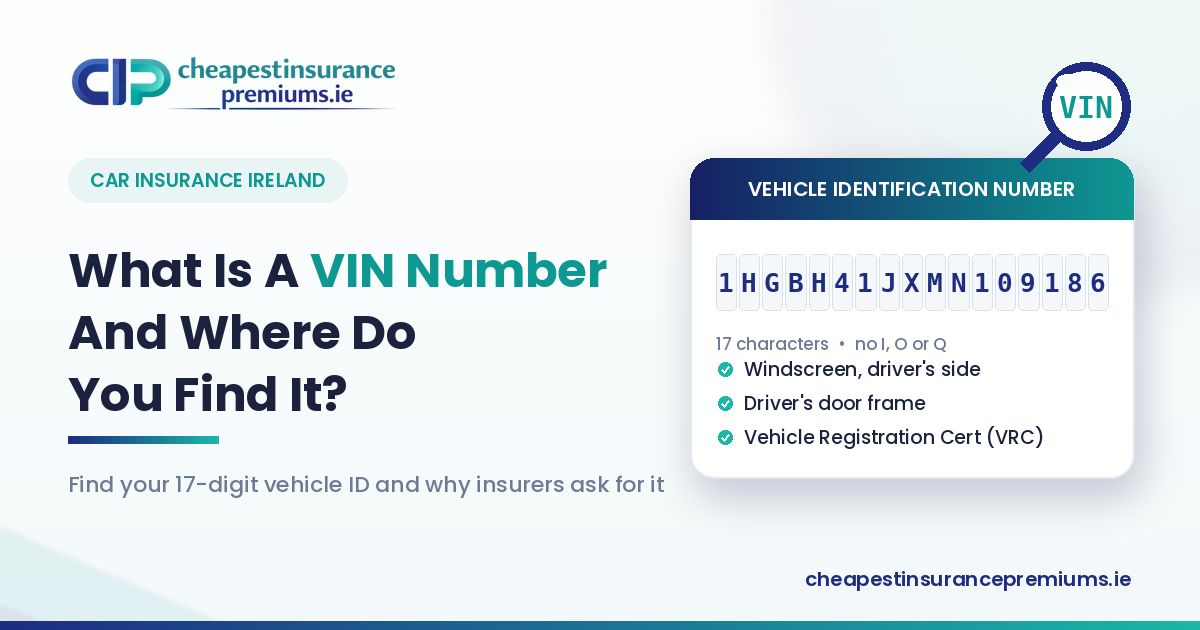
A VIN (Vehicle Identification Number) is a 17-character code assigned to a vehicle at the point of manufacture. It identifies that specific vehicle, not the model. Two identical cars rolling off the same line on the same morning carry different VINs.
Three things make it useful:
It is permanent. It is assigned once and stays with the vehicle for life, through resprays, engine swaps, changes of ownership and changes of country.
It is physically marked on the vehicle. Under the standards Irish and EU vehicles are built to, the VIN number must be permanently marked on the vehicle structure itself, as well as appearing on the manufacturer’s plate.
It is unique for at least 30 years. Manufacturer identifier codes are coordinated internationally so that no two vehicles share a VIN within that window.
That combination is why the VIN, rather than the reg, is the anchor point for recalls, history checks, insurance records and vehicle registration.
Two quirks worth knowing. First, the letters I, O and Q never appear in a VIN. They were excluded deliberately so they cannot be mistaken for 1 and 0. If you think you have spotted one, look again. Second, the 17-character format only became the international standard in 1981. A shorter code is not necessarily a red flag; it usually just means the car is older than that.
VIN Number, Chassis Number, Engine Number, Reg: What Is The Difference?
In Ireland these four get used loosely and sometimes interchangeably, which causes problems at exactly the wrong moment. They are not the same thing.
| Identifier | What it identifies | Does it change? | Where you will be asked for it |
| VIN number | The individual vehicle | No | Recalls, imports, insurance, history checks |
| Chassis number | The same code as the VIN number. The term simply refers to where it is stamped | No | Used interchangeably with VIN number in Irish paperwork |
| Engine number | The engine, not the car | Yes, engines can be replaced | Some garage work, some older or classic policies |
| Registration number | The registration record, tied to a jurisdiction | Yes, changes on import and can be re-assigned | Motor tax, NCT booking, day-to-day admin |
So when an Irish form asks for a “chassis number”, it wants your VIN number. When it asks for an engine number, it wants something different, and quoting the VIN will not do.
How To Read A VIN Number
The code follows ISO 3779, the international standard for VIN structure. It splits into three sections.
| Characters | Section | What it tells you |
| 1 to 3 | World Manufacturer Identifier (WMI) | Who built the vehicle, and where |
| 4 to 9 | Vehicle Descriptor Section (VDS) | Model, body style, engine type and other general attributes |
| 10 to 17 | Vehicle Indicator Section (VIS) | Model year, assembly plant and serial number. The last four characters are always numeric |
The WMI is issued by a national body. In Ireland that is the National Standards Authority of Ireland (NSAI), which assigns WMI codes to Irish-based vehicle and trailer manufacturers and notifies the international coordinator so the code is logged globally. That matters mainly to small-series manufacturers and trailer builders here, but it is the reason an Irish-built trailer has a traceable identity at all.
The middle section is the part a parts supplier cares about. It is why a garage can tell, from the code alone, that your car is the 1.5-litre variant with the different rear beam and not the 1.0 that shares the same badge.
The final section varies most between manufacturers. Some encode the model year in character ten to a published schedule; others do not. This is why VIN decoders sometimes disagree with each other, and why a manufacturer’s own checker is more reliable than a generic third-party one.
You do not need to memories any of this. It is enough to know the code is structured rather than random, which is what makes a fake one hard to construct convincingly.
Where To Find The VIN Number On Your Car
Locations vary by manufacturer, but on most modern cars you have several options.
The windscreen. On the driver’s side, at the base of the glass, there is usually a small cut-out in the trim showing the VIN so it can be read from outside the car. This is the quickest check and the one to use if you are standing beside a car you do not own yet.
The driver’s door pillar or door shut. Open the driver’s door and look at the pillar and the surrounding shut area. There is normally a sticker or riveted plate carrying the VIN number alongside tyre pressures, weights and paint code.
Stamped into the body or chassis. Common locations are the engine bay (on the bulkhead or a suspension turret), the floorpan near the front seats, sometimes under a lift-up flap in the carpet, and the boot floor near the spare wheel well. On some models it sits under a plastic trim panel that has to be unclipped.
Under the bonnet, on the manufacturer’s plate. The statutory plate carries the VIN along with type-approval details and weight ratings.
One rule to remember: if the sticker and the stamped number disagree, the stamped number is the definitive one. Stickers and plates can be damaged, replaced or falsified. A number stamped into structural metal cannot be altered without leaving evidence.
The same locations apply to light commercials, so if you are checking a VIN on a van before insuring it, start at the door pillar and the bulkhead.
Where To Find The VIN Number On Your Paperwork
Your Vehicle Registration Certificate (VRC) is the primary document. Issued by the Department of Transport, it lists the VIN alongside the registration number, make, model and registered owner details. If you only check one document, check this one.
A hire purchase or PCP agreement will normally carry it too, because the finance company needs to identify the exact vehicle it holds an interest in.
Import documentation is the other reliable source. A car brought in from the UK will have the VIN number on the V5C. EU imports will show it on the equivalent national registration document, and it will also appear on the Certificate of Conformity.
Your insurance documents and previous NCT reports are also worth checking if the above are missing.
Why Your Insurer Asks For Your VIN Number
This is where the VIN moves from administrative trivia to something that can affect a claim.
For a standard Irish-registered car, most quotes run off the registration number and insurers pull the vehicle details from there. The VIN sits in the background. But there are situations where it becomes central.
Imports. An imported car often will not return correct details from a reg lookup, and the specification may differ meaningfully from the Irish-market version of the same model: different engine, different trim, sometimes different safety equipment. Insurers price accordingly, and the VIN is how the actual specification gets confirmed. Failing to disclose that a car is an import is a non-disclosure issue that can affect whether a claim is paid, so flag it when you compare motor insurance quotes.
Cover before an Irish reg exists. If you have landed a car and it has no Irish registration yet, you still need cover to move it legally. Not every insurer will write a policy against a chassis number, and this is one of the more common friction points in the import process. It is worth confirming before the car arrives rather than after.
Total loss and theft claims. When a vehicle is written off or stolen, the VIN number is the identifier used in the claim record and in any recovery.
Modified, classic and non-standard vehicles. Where an engineer’s report or specialist valuation is involved, the VIN ties the report to the specific car.
Commercial vehicles. The same applies to imported or converted vans, where spec differences drive the price. Have the VIN ready when you look at van insurance or wider commercial insurance cover.
If you are arranging cover on an import or a non-standard vehicle, have the VIN to hand when you make the call. It shortens the conversation considerably.
How To Check A VIN Number For Recalls In Ireland
A recall happens when a manufacturer identifies a safety defect and calls affected vehicles back for a free repair. Recalls are issued against specific vehicles, not against every car of that make and model, which is precisely why the check is done by VIN number.
Two places to look:
The manufacturer’s own recall checker. Most brands operate one. You enter the VIN and it tells you whether that vehicle has an open campaign against it.
The RSA’s recall listings. As Ireland’s Automotive Market Surveillance Authority, the RSA publishes current recall campaigns by manufacturer, including how many vehicles in the State are affected and how to check yours.
One thing worth being clear about: the NCT does not identify recall campaigns. Passing the test tells you nothing about whether an open recall exists on your car. The RSA states this explicitly. If you have bought a second-hand car, the previous owner may or may not have had the work done, and an authorised dealer can confirm it against the VIN.
Using The VIN Number When Buying A Used Car
Most private used car purchases in Ireland happen without anyone checking a VIN. It is the single cheapest check available and it is the one that confirms the car is what the seller says it is.
Before money changes hands, check the VIN number in every location it appears on the car, and compare all of them to the VRC. Not one location. All of them.
A mismatch is a serious warning. The two scenarios it typically indicates:
Cloning. A stolen vehicle given the identity of a legitimate, similar car. You risk buying a car that is later seized, with no compensation.
A “cut and shut”. Two crash-damaged vehicles cut and welded together into one. Structurally compromised, and genuinely dangerous in an impact.
Either way, the answer is the same: walk away, and do not accept an explanation.
A vehicle history check is run using the registration number, but the report returns the VIN held on record, so it gives you a third data point to compare against the car and the VRC, alongside write-off history, outstanding finance, mileage records and previous ownership. If any of the three disagree, stop.
Once the car checks out, run the reg through a motor insurance quote before you commit, because premium is part of the true cost of the car.
Importing A Car? You Will Need The VIN Number
Bringing a vehicle into Ireland puts you on a fixed timetable:
- Book your NCTS appointment within 7 days of the vehicle entering the State.
- Complete registration within 30 days of arrival. Missing this can trigger an additional VRT charge.
- The vehicle needs an electronic Certificate of Conformity (e-CoC) before it can be registered.
At the inspection you will be asked to point out the VIN on the vehicle so the inspector can verify it against the documentation. Knowing exactly where it is before you arrive saves you crawling around a car park with a torch.
Once registration is complete and the VRT is paid, you get a receipt showing your Irish registration number, plates must be displayed within 3 days, and a Form RF100 for motor tax. To pay motor tax you need insurance in place, so arranging cover is not the last step. It sits in the middle of the process. If you are importing a van rather than a car, start the van insurance quote at the same point.
Common VIN Number Problems And What To Do
The plate or sticker is missing or damaged. Fall back on the stamped number in the body or chassis, and cross-check against the VRC.
You cannot find the VIN anywhere. Check the owner’s manual, as most list the marking locations for that specific model. Failing that, a main dealer for the brand will know.
The VIN number on the car does not match the VRC. If you own the car, contact the Department of Transport to resolve the record. If you are buying, do not proceed.
The VIN looks re-stamped, ground down or freshly painted over. Treat this as a stop signal, not a curiosity.
It is only 11 or 13 characters. For a pre-1981 vehicle this is normal. For anything newer, it is not.
Frequently Asked Questions About VIN Numbers
Is a VIN number the same as a chassis number?
Yes. In Ireland the terms are used interchangeably, and “chassis number” refers to where the code is stamped on the vehicle. The engine number is a separate identifier and is not the same thing.
How many characters is a VIN number?
Seventeen, on any vehicle built since 1981. It never contains the letters I, O or Q.
Where is the VIN number on my car?
Most commonly at the base of the driver’s-side windscreen, on the driver’s door pillar, and stamped into the body, typically the engine bay, floorpan or boot floor. Exact locations vary by manufacturer.
Can I check a VIN number for free in Ireland?
Manufacturer recall checkers are free. Full vehicle history reports covering finance, write-offs and mileage are paid services and are run using the registration number, with the VIN returned on the report.
Does the VIN number change if I import a car?
No. The vehicle gets a new Irish registration number, but the VIN stays exactly as it was.
Do I need the VIN number to get car insurance?
Not usually for a standard Irish-registered car, where the reg is enough. It becomes important for imports, non-standard or modified vehicles, and any situation where cover is needed before an Irish registration has been issued.
Final Thoughts
The VIN number is the one thing about your car that cannot be changed: 17 characters, fixed at manufacture, stamped into the metal and recorded on the VRC. Check it on the car, check it on the certificate, and if the two ever disagree, believe the car.
If you are arranging cover on an import or a non-standard vehicle and you are not sure what your insurer will need, get a quote or talk to us before the car lands. It is a much easier conversation to have in advance. You can also compare home insurance and travel insurance in the same place, and there are more car ownership guides on our blog.
Sources
- Citizens Information, importing a vehicle into Ireland
- Revenue, Vehicle Registration Tax (VRT)
- Revenue, importing vehicles from Great Britain and Northern Ireland
- Road Safety Authority, Automotive Market Surveillance Authority vehicle recalls
- NSAI, World Manufacturer Identifier
- ISO 3780:2009, road vehicles world manufacturer identifier code
- Consumer Insurance Contracts Act 2019, Section 8