What the test costs, how long it takes, what to bring, and what actually makes a difference on the day. Knowing how to pass your driving test in Ireland is only half the job. The other half is turning up with the right paperwork, in a car that will not be turned away, on a date you did not wait a year for.
This guide covers what the test costs, how long it takes, what to bring, and the 2026 rule changes that are catching people out at the centre door.
How Much Is the Driving Test in Ireland?
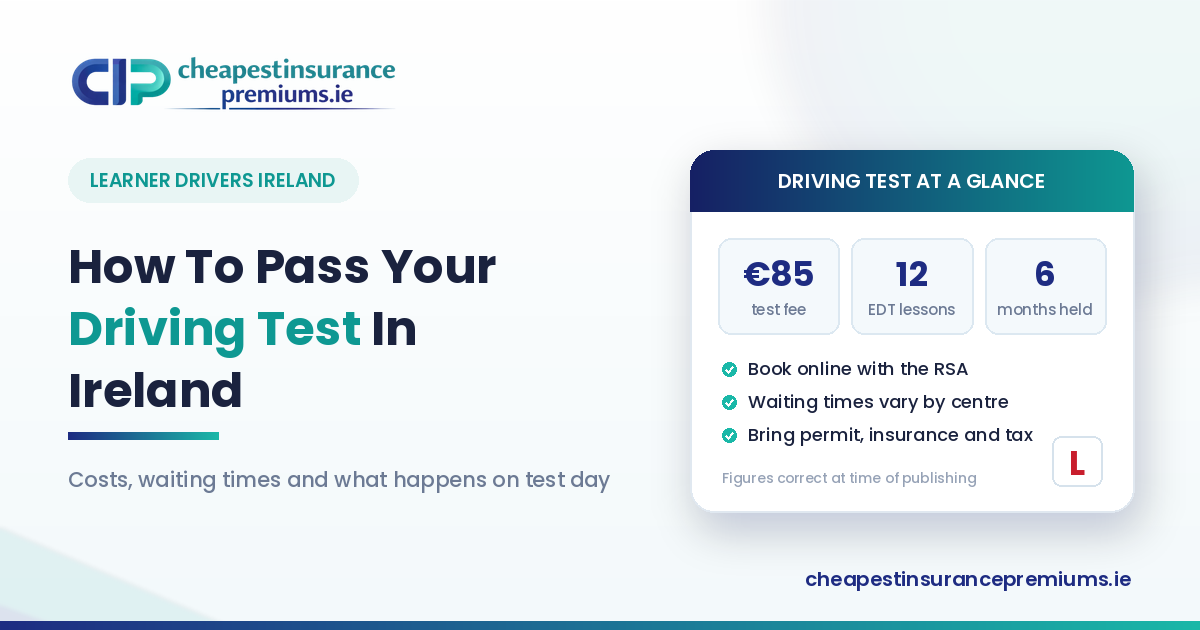
The test itself is €85 for a category B car test, payable when you apply. Every other category, including motorbike with trailer and truck, is €120.
That €85 is the smallest part of what learning to drive costs. Here is the full picture as it stands in 2026:
| Item | Typical cost |
| Driver theory test | €45 per attempt |
| Learner permit | €45 (up from €35 on 1 January 2026) |
| 12 EDT lessons | €500 to €750, commonly around €550 |
| Practical driving test | €85 per attempt |
| First full licence (NDLS) | Separate fee, payable after you pass |
| Instructor’s car on test day | €80 to €120 if you do not have your own |
Stick strictly to the mandatory steps and you are looking at roughly €770 to €900. Add the pre-test lessons and test-day car hire most learners actually take, and the realistic figure is closer to €1,100 to €1,650.
Two ways to keep it down. Book EDT as a block rather than lesson by lesson, which is commonly €30 to €60 cheaper. And do not sit the test before you are ready: at €85 plus car hire, one retake wipes out any saving from rushing.
Insurance is the cost people forget entirely. Budget for it early, because you cannot sit the test without it.
How Long Does the Driving Test Take in Ireland?
Two different answers, and people usually want both.
The appointment: the RSA puts the whole test at roughly 50 to 100 minutes depending on the vehicle category. For a car test, allow about an hour and a half at the centre from arrival to walking back out with your result.
The drive itself: roughly 30 to 40 minutes behind the wheel, covering about 8 kilometres, or 5 miles, of varied roads and traffic.
The rest of the appointment is the parts people forget to prepare for: the document check, the eyesight check where you read a number plate at a distance, questions on the Rules of the Road, identifying road signs, and demonstrating hand signals. All of that happens before you move.
Within the drive you will be asked to reverse around a corner, perform a turnabout, and do a hill start. The examiner marks faults on a standard sheet as you go, and hands you the result when you get back.
Practical point: do not schedule anything tight after your slot. Between the paperwork, the test and the debrief, budget two hours from leaving home to being free again.
What To Bring To Your Driving Test in Ireland
Get this list right and you remove the most common reason people are turned away before they drive.
Documents:
- Your valid learner permit, the plastic card itself, not a photocopy or a photo of it
- A valid certificate of motor insurance naming you as a driver of the test vehicle
- If you are not named on the certificate, you need the certificate and a letter or email from the insurer, on headed paper, confirming you are insured to drive that specific vehicle
- Corrective lenses if you need them to drive
The car:
- Valid, original insurance disc displayed, showing the registration and policy dates
- Valid, original motor tax disc
- Valid NCT disc, if the car is old enough to need one
- L-plates front and rear, red L on white, at least 15cm high with a 2cm border
- Roadworthy overall: lights, indicators, brake lights, tyres, mirrors, seatbelts
Your EDT logbook is not required at the centre, but your twelve lessons do need to be recorded with the RSA before you are eligible.
Check the car the night before, not the morning of. A blown brake light is a five minute fix the evening before and a cancelled test at 9am.
The 2026 Rule Changes To Know About
Proof of insurance is now checked at the door
Since 9 March 2026, candidates must show proof they are insured to drive the test vehicle. This caught a lot of people out in the early weeks.
The important detail, and one a lot of coverage got wrong: the RSA accepts an original certificate or a copy, and digital versions are acceptable. You do not need to wait on the post for a paper original.
What matters is that the certificate names you as a driver of that specific car. If it does not, that is when you need the additional letter or email from the insurer. That letter is the piece worth requesting early, because it has to come from the insurer and it will not arrive the same morning.
If you are using a driving school car, ask the school in advance exactly what they will hand you and check it covers you by name.
Learner permit renewals change from 1 November 2026
From 1 November 2026, you will not be able to renew a third or subsequent learner permit unless you have actually sat a driving test in the previous two years.
If you are on your third permit or beyond and have never sat a test, this affects you directly and the deadline is close. Get on the waiting list now rather than after your permit lapses, because driving on an expired permit is not legal and it is not insurable.
How To Book and Apply for a Driving Test in Ireland
You apply and book through MyRoadSafety, the RSA’s online portal, where you also manage your permit, reschedule and cancel.
The sequence is fixed:
- Pass the driver theory test
- Apply for your learner permit
- Hold a first category B permit for at least six months before you can sit the practical test
- Complete your 12 EDT lessons, logged by your instructor
- Apply for the test and pay the €85
- Wait for a booking invitation by email, then choose your slot
You can join the waiting list before you have finished EDT. You cannot sit the test until both the six months and the twelve lessons are done, but given the current waits, applying early is what lines the two up. If you are booked and turn out not to be eligible, the RSA cancels the test five days out, keeps your fee and puts you back in the queue.
How Long Is the Wait for a Driving Test in Ireland?
It depends on where you look and where you book.
The national average has been running somewhere in the region of twelve to sixteen weeks, depending on which measure you use. The RSA and CSO track slightly different things, and the figure moves month to month. The RSA has been adding centres and testers, and waits have come down a long way from the peaks of early 2026, when they were closer to six months.
But the national average hides enormous variation. Some centres are quoting a few weeks. Others, mostly Dublin ones, are still quoting well over twenty. There have been roughly a hundred thousand learners on the waiting list nationally.
The practical takeaway: the average does not matter to you. Your centre’s number does. Check the estimator on MyRoadSafety before you assume anything.
Where You Book Your Driving Test Matters
Two things vary between centres: how long you wait, and how likely you are to pass.
Broadly, busy urban centres, particularly in Dublin and Cork, have longer waits and lower pass rates. Smaller rural centres tend to have shorter queues and higher pass rates. It is not that rural examiners are softer. It is that the routes typically involve less heavy traffic, fewer complex junctions and less of the stop-start pressure that trips people up.
You choose your preferred centre when you book through MyRoadSafety, and you can change it. A drive of an hour or so to a quieter centre can genuinely save months.
There is a trade-off worth being honest about. Every centre has its own set of test routes around it, and you will do better on roads you have actually driven. If you switch to a distant centre, budget for a lesson or two locally with an instructor who knows the area before test day. Turning up cold to unfamiliar roads can undo the advantage.
Does the Time of Year Matter?
A little, but not much. Pass rates do wobble across the calendar. Winter months tend to sit slightly lower, which is what you would expect from dark evenings and bad weather, but the gap between the best and worst months is a percentage point or two.
It is real, but it is small. Do not turn down a slot in December to wait for a “better” month. Being properly prepared matters far more than which month is on the certificate.
How To Get a Driving Test Sooner
- Apply early. You can join the queue before EDT is finished, and the wait usually covers the gap.
- Check for cancellations. Short-notice slots appear on MyRoadSafety and go quickly.
- Consider a quieter centre, with the route caveat above.
- Be available at awkward times. Testing hours run into early mornings, evenings and Saturdays.
- Cancel early if you cannot attend. Free rescheduling if your test is more than ten days out, and it frees the slot for someone else.
- Keep your permit valid. An expired permit means no test.
How To Pass Your Driving Test: What Actually Helps
- Practise the actual test routes. Instructors know them. Drive them at the time of day your test is booked for.
- Take a pre-test lesson. An instructor running a mock test spots the habits you cannot see in yourself.
- Learn the technical questions properly. They come first, and fumbling them sets the tone. Know what is under the bonnet and what each fluid does.
- Rehearse the three manoeuvres. Reverse around a corner, turnabout, hill start. These are known in advance, so there is no excuse for being shaky on them.
- Know the common faults. Observation at junctions, mirror checks before signalling, road position and clutch control on hills account for a large share of failures.
- Make reasonable progress. Driving too slowly fails people as reliably as driving too fast. Hesitancy at junctions and roundabouts is marked.
- Sleep, eat, leave early. Arriving flustered costs marks before you have moved.
Does the time of year matter? A little. Pass rates dip slightly in winter, which is what you would expect from dark evenings and bad weather, but the gap is a percentage point or two. Do not turn down a December slot waiting for a better month. Preparation matters far more.
Insurance While You Are Learning
You need to be insured to drive, and to sit the test. Two routes are usual:
- Added as a named driver on a parent’s or partner’s policy. Cheaper, but the car’s owner must be the main driver. Putting a learner down as an occasional user of a car they actually drive most of the time is called fronting, and it can void the policy at exactly the moment you need it.
- Your own learner policy in your own name, which starts building your own no claims bonus from day one. Those years of no claims are worth real money later, and they only start counting once a policy is in your name.
Either way, remember a learner can only drive accompanied by someone who has held a full licence in that category for at least two years. Whichever route suits, you can compare motor insurance quotes across insurers rather than taking the first number you are given.
A Note for Parents Adding a Learner
If you are the one putting a son or daughter on your policy, two things are worth doing in the same phone call.
First, check that the declared main driver genuinely reflects who drives the car most. Getting that wrong is the single most common way a family policy ends up unenforceable. Our guide to motor insurance sets out how insurers assess it.
Second, since you have the policy documents open anyway, it is a sensible moment to look at the rest. Most households have not touched their home insurance sums insured in years, and rebuild and contents figures drift quietly. If yours have not been reviewed since you took the policy out, get a home insurance quote and compare while you are at it.
Can You Drive Straight After Passing Your Test in Ireland?
Not on your own, no. This one catches people out badly.
When you pass, the examiner hands you a Certificate of Competency on the spot. That certificate is proof you passed. It is not a driving licence.
Until the physical full licence card is in your hand, you are still a learner permit holder in the eyes of the law. That means you must keep driving accompanied, keep the L-plates on, and stay off motorways. Driving unaccompanied on the strength of a certificate of competency is an offence, and your insurer can treat it the same way.
You take the certificate, your learner permit and the fee to the NDLS to apply for the full licence, and the card arrives by post within roughly a week. Once it does, the rules change: L-plates come off, and N-plates go on for two years, red N on white, same size and border rules as the L-plates. A lower drink-drive limit applies to novice drivers, and a lower penalty point threshold too.
Tell your insurer the day the licence arrives. Licence status is a material fact, and passing usually improves the terms available to you.
After You Pass, Shop Around Properly
Premiums for newly qualified drivers vary enormously between insurers, far more than they do for experienced drivers, and the gap between the best and worst quote at this stage can run into four figures.
That makes the weeks after passing the single most valuable time in your driving life to compare the market rather than accepting whatever renewal lands.
If You Will Be Driving for Work
A category B licence covers vans up to 3,500kg, so plenty of newly qualified drivers go straight into a work vehicle. The insurance is a different product though, and a private policy will not respond if the vehicle is being used for a trade.
If that is where you are heading, price it properly with a van insurance quote, and be straight about class of use and whether you carry tools or goods. You can cost a van policy here.
Where the vehicle is part of a business, it usually sits alongside other exposures such as public liability and tools cover, which is a commercial insurance conversation rather than a motor one. Starting out on your own? You can get a sole trader business insurance quote and keep the cover matched to the work.
Thinking Ahead to Driving Abroad
Once you have the full licence, hiring a car on holiday becomes an option, but not immediately. Most rental companies abroad require a licence held for at least one year, sometimes two, and many apply a young driver surcharge on top.
Worth knowing before you book. And whether you are hiring or taking your own car on the ferry, sort travel insurance for the people in the car, because a motor policy covers the vehicle and your liability, not medical costs or repatriation.
Our Final Thought
Two things are within your control: where you book, and how ready you are when you get there.
Apply early, pick a centre with a realistic wait, practise the routes around it, and sort the insurance documentation weeks before the date rather than days. Do that and you have removed most of the reasons people fail or get turned away.
Sorting insurance for a learner or a newly qualified driver? Cheapest Insurance Premiums is a Central Bank of Ireland regulated brokerage. We will get you the certificate and the confirmation letter you need for test day, and compare cover across insurers once you have passed. Get in touch if you would rather talk it through, read our blog for more plain-English guides, or start from the Cheapest Insurance Premiums homepage.
Frequently Asked Questions
How much is the driving test in Ireland?
€85 for a category B car test, and €120 for most other categories. Across the whole process, budget roughly €770 to €900 for the mandatory steps and €1,100 to €1,650 realistically once extra lessons and test-day car hire are included.
How long is the driving test in Ireland?
The full appointment runs about 50 to 100 minutes depending on the category. For a car test, the drive itself is roughly 30 to 40 minutes covering about 8km, with the document check, eyesight check and Rules of the Road questions before it. Allow an hour and a half at the centre.
How long does a driving test take from start to finish?
Budget two hours from leaving home to being free again. That covers arriving early, the pre-drive checks and questions, the 30 to 40 minute drive, and getting your result.
What do I need to bring to my driving test in Ireland?
Your plastic learner permit, a valid motor insurance certificate naming you as a driver of the test car, and a letter or email from the insurer if you are not named on it. The car needs valid insurance and tax discs displayed, an NCT disc if applicable, L-plates front and rear, and to be roadworthy.
Do I need a paper insurance certificate for the driving test?
A named driver arrangement is usually cheaper up front, but your own policy starts building your no claims bonus immediately, which is worth real money within a few years. The right answer depends on how much you drive and whose car it is.
How do I book a driving test in Ireland?
Apply through MyRoadSafety once you hold a learner permit. You will be emailed a booking invitation when you reach the front of the queue. You cannot sit the test until you have held a first category B permit for six months and completed your twelve EDT lessons.
How do I apply for a driving test?
Pass the theory test, get your learner permit, then apply on MyRoadSafety and pay the €85 fee. You can apply before finishing EDT, and given current waiting times, most people should.
How long is the wait for a driving test in Ireland?
Recently around eleven to sixteen weeks nationally, but individual centres vary from a few weeks to over twenty. Check the RSA waiting time estimator for your chosen centre rather than relying on the national figure.
How do I pass my driving test in Ireland?
Practise the routes around your test centre, take a pre-test lesson under test conditions, rehearse the three set manoeuvres, learn the technical questions, and make reasonable progress rather than driving hesitantly. Most failures come from observation at junctions, mirror use and road position.
Can you drive straight after passing your test in Ireland?
Not unaccompanied. You get a Certificate of Competency on the day, but you remain a learner permit holder until the physical full licence arrives from the NDLS. Keep the L-plates on, stay accompanied and stay off motorways until then. After that, N-plates for two years.
Is it cheaper to be a named driver or have my own learner policy?
A named driver arrangement is usually cheaper up front, but your own policy starts building your no claims bonus immediately, which is worth real money within a few years. The right answer depends on how much you drive and whose car it is.