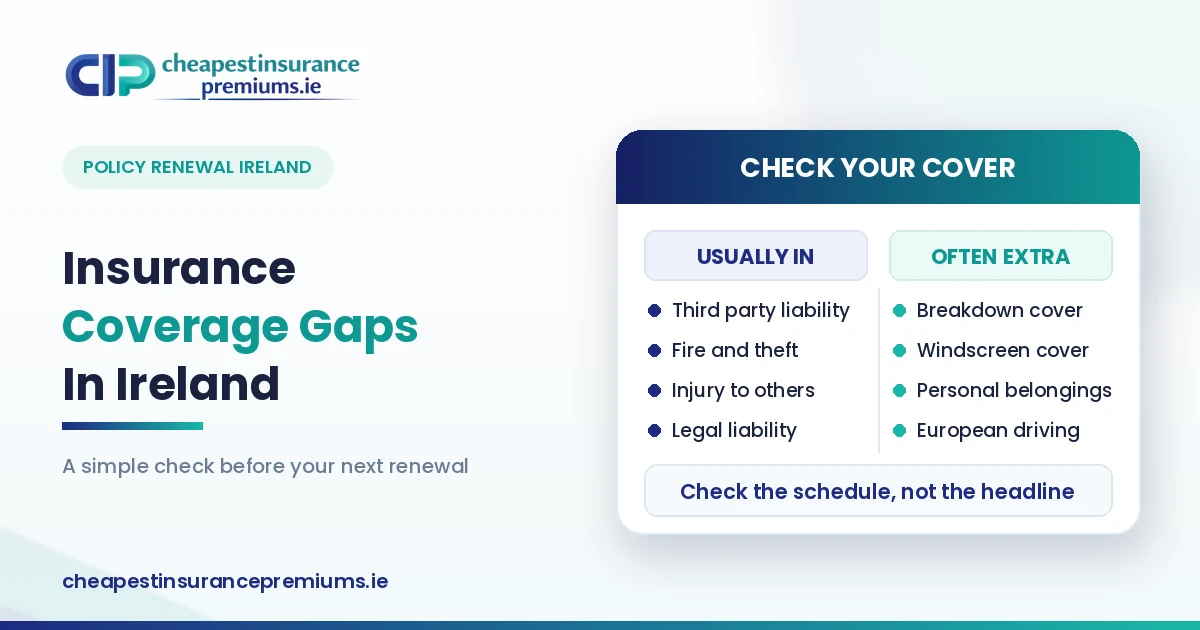
Most Irish drivers and homeowners have insurance in place. Far fewer have the right amount of insurance in place. Insurance coverage gaps are the difference between the cover you pay for and the cover you actually need, and they only ever show up at the worst possible moment: after a break-in, a burst pipe, a storm or a crash. You hand in the claim, and the payout is smaller than you expected.
The good news is that checking for insurance coverage gaps takes about half an hour. Here is what to look for.
What Insurance Coverage Gaps Actually Mean
The idea is simple: the cover you are paying for is less than what it would cost to put things right.
It usually happens slowly, without you doing anything wrong.
Say you insured your house for a €300,000 rebuild when you bought it. Building costs have climbed a lot since then. The real figure today might be €400,000. Your premium has crept up each year, so it feels like your cover has kept pace. It has not. The sum insured on the policy is the number that matters, and nobody changed it.
The same thing happens with contents, with cars, and with anything you have bought since you last read your policy.
Car Insurance Coverage Gaps: Where They Appear
Market Value vs What You Paid
Comprehensive cover does not mean you get a replacement car. If your car is written off, most motor insurance policies pay the market value on the day of the claim, which is what your car is worth now, not what you paid for it.
Buy a car for €25,000, write it off two years later, and you might be offered €18,000. If you still owe €20,000 on finance, you are €2,000 short and you have no car.
What to check: Whether your policy pays market value or agreed value, and whether you have a finance shortfall. If you do, ask about GAP cover. When you are pricing your own car, use the exact spec rather than a rough guess. Your VIN number tells you the precise model and trim, which is often worth a few thousand euro either way.
Windscreen and Glass Cover
Most comprehensive policies include glass cover, but there is usually an excess, and sometimes a cap on how many glass claims you can make in a year. With Irish roads and Irish weather, this one gets used more than people expect.
What to check: Your windscreen excess, and any annual limit on glass claims. Also check whether using an approved repairer keeps your excess lower.
Personal Belongings in the Car
The laptop on the back seat, the golf clubs in the boot, the buggy: standard car insurance usually does not cover personal items stolen from the car. People often find this out the week after a break-in.
What to check: Whether personal belongings are covered at all and up to what limit. Your home contents policy may cover items away from the home, which is often the better route. If the items go abroad with you, travel insurance is usually the right place for them instead.
Driving Other Cars
“Driving other cars” cover sounds handy, but the conditions catch people out. It is often third party only, frequently limited to certain policyholders, and it usually does not cover a car owned by someone in your own household.
What to check: Whether you actually have this extension, and read the conditions rather than assuming. If more than one car in the house needs cover, it is worth pricing each car properly instead of relying on an extension that may not apply.
Who Is on the Policy, and Who Is Driving
If someone drives your car regularly, they should be on the policy. Leaving them off can invalidate a claim. Equally, adding a driver who barely uses the car can cost you money for no reason.
What to check: That your named drivers match who actually drives the car, and that your stated mileage and use (social, commuting, business) are still accurate. While you have the paperwork out, it takes a minute to check the motor tax on the car too.
Your No Claims Bonus
Years of no claims are worth real money, and one claim can wipe out a chunk of it. Step-back or protected bonus cover holds most of that value if you do claim.
What to check: Whether your no claims bonus is protected, and what it would drop to after one claim. If it is not protected, ask what protection costs when you next compare motor quotes.
Home Insurance Coverage Gaps: The Hidden Shortfalls
Buildings Cover and Rebuild Costs
This is the biggest gap in Irish home insurance.
Your buildings sum insured should be the cost to rebuild your home: demolition, site clearance, materials, labour, architect and engineer fees. It has nothing to do with what the house is worth on the market or what you paid for it.
Rebuild costs have risen sharply. Most people set their figure once and never touch it again.
What to check: Use the Society of Chartered Surveyors Ireland house rebuilding cost guide, or get a professional assessment, and compare it to the sum insured on your schedule. If you have added an extension or an attic conversion since, the old figure is definitely wrong.
Contents Cover Undervaluation
Walk through the house room by room and add it up: furniture, TVs, laptops, clothes, kitchen gear, tools, garden furniture, bikes. Most homes come to €50,000 or more. Most policies are set well below that.
What to check: Do a real inventory. Photograph each room and keep receipts for the big items in a folder or in cloud storage. It usually shows that €30,000 of contents cover should be closer to €60,000. Once you have a realistic number, get a home insurance quote based on that figure rather than the old one.
High-Value Items and Single Item Limits
Standard contents policies have a single item limit, often somewhere between €1,500 and €3,000. Anything worth more than that has to be listed separately, or you will only get the limit.
Engagement rings, watches, jewellery, cameras, road bikes, musical instruments and art are the usual casualties.
What to check: Your single item limit, then list anything above it. Get valuations for the expensive pieces and have them specified on the policy.
Accidental Damage
Standard home policies cover named events: fire, storm, flood, theft, escape of water. Accidental damage is normally an optional add-on. Without it, you are not covered for the football through the patio door, the wine on the cream carpet, or the drill through a pipe.
What to check: Whether accidental damage is included, and what it costs to add. It is usually a small amount relative to what it saves.
Home Office and Business Equipment
Working from home has put real money into spare rooms: monitors, desks, chairs, printers, laptops. Your employer’s insurance may cover company-owned kit. Your own equipment often falls into a grey area, and business use can be excluded entirely.
What to check: Add up your setup and confirm it is covered. If you are self-employed or run a business from the house, look at commercial insurance or a sole trader business quote rather than assuming the home policy stretches that far. If you use a van for work, that needs its own van insurance policy on the correct class of use.
Time the House Is Left Empty
Most home policies restrict cover once a property is unoccupied for a set period, commonly 30 to 60 days. Long trips, work abroad, a house being renovated or an inherited property left idle can all quietly breach that condition.
What to check: The unoccupancy clause in your wording. If a property will be empty for a while, or if it is a second home you only use in summer, tell your insurer before it happens rather than after.
How to Check for Insurance Coverage Gaps Yourself
Gather Your Documents
You need the full policy wording, not just the renewal letter. The renewal letter tells you the price. The wording tells you what you actually bought.
Review Your Sums Insured
Buildings: rebuild cost, not market value. Contents: a room-by-room inventory. Car: check what your model is currently selling for on Irish sites.
Read the Detail, Not Just the Schedule
Look at three things in particular: exclusions, limits and conditions. Most complaints about claims come down to one of those three, not to anything hidden or unfair.
Think About What Has Changed
Extension built. Attic converted. New kitchen. Engagement ring. New car. Someone moved in. Working from home now. Any of these can move you out of line with your policy.
Ask the Only Question That Matters
If this happened tomorrow, what would I be paid, and what would I have to fund myself? If you cannot answer that, you have not finished the check.
Fixing the Insurance Coverage Gaps You Find
Increase Your Sums Insured
Call your insurer or broker and adjust the figures. Your premium will go up. You are swapping a false sense of security for actual cover, which is what you thought you were buying.
Add the Missing Bits
Accidental damage, specified items, personal belongings, protected no claims bonus, breakdown assistance. Add what fits your life and skip what does not.
Compare Before You Renew
If your current insurer cannot give you the cover you need at a sensible price, it is time to look elsewhere. Comparing the market lets you see what the same level of cover costs across insurers instead of guessing. Do that a few weeks before renewal day rather than on it, while you still have time to ask questions instead of just clicking accept. Whether it is a car, a house or a van, the exercise is the same.
The Real Cost of Being Underinsured
There is a clause in most policies called average. If you are underinsured, the insurer can reduce your payout by the same proportion.
Here is how that works in practice:
- Rebuild cost: €400,000
- Sum insured: €300,000, which is 75% of what it should be
- Storm damage claim: €50,000
- Payout: €37,500
You are €12,500 short on a claim that had nothing to do with a total rebuild. Insurance coverage gaps do not just bite on big claims. They bite on every claim.
Getting It Right
You already pay for insurance every year. The only question is whether it will do its job when you need it.
Half an hour with your policy documents, a rebuild figure and a contents list will tell you. Most people find one or two gaps. Some find they are paying for cover they do not need, which is worth knowing too.
Need a hand with it? Cheapest Insurance Premiums compares cover across Irish insurers so you can see where you stand on price and on cover. Get your quotes here, read more guides on the blog, or contact us if you want to talk something through first.
Frequently Asked Questions
How do I know if my home is underinsured?
Compare your buildings sum insured against a current rebuild cost estimate, using the SCSI house rebuilding cost guide or a professional assessment. If your sum insured is lower, you are underinsured, and the average clause can reduce any claim you make.
Does buildings insurance cover the market value of my house?
No. Buildings insurance covers the cost of rebuilding the property, including demolition, site clearance and professional fees. That figure can be higher or lower than the market value, because market value includes the site itself.
Are my belongings covered if they are stolen from my car?
Usually not under the car policy. Personal items in a vehicle are often excluded or capped at a low limit. Some home contents policies cover personal effects away from the home, so check that wording first.
What is a single item limit?
It is the maximum a contents policy will pay for any one item, often between €1,500 and €3,000. Anything worth more needs to be listed individually on the policy, usually with a valuation.
Should I fix insurance coverage gaps mid-policy or wait for renewal?
You can usually adjust sums insured mid-policy, and it is worth doing straight away if you have found a real gap. Waiting means carrying the risk until renewal.